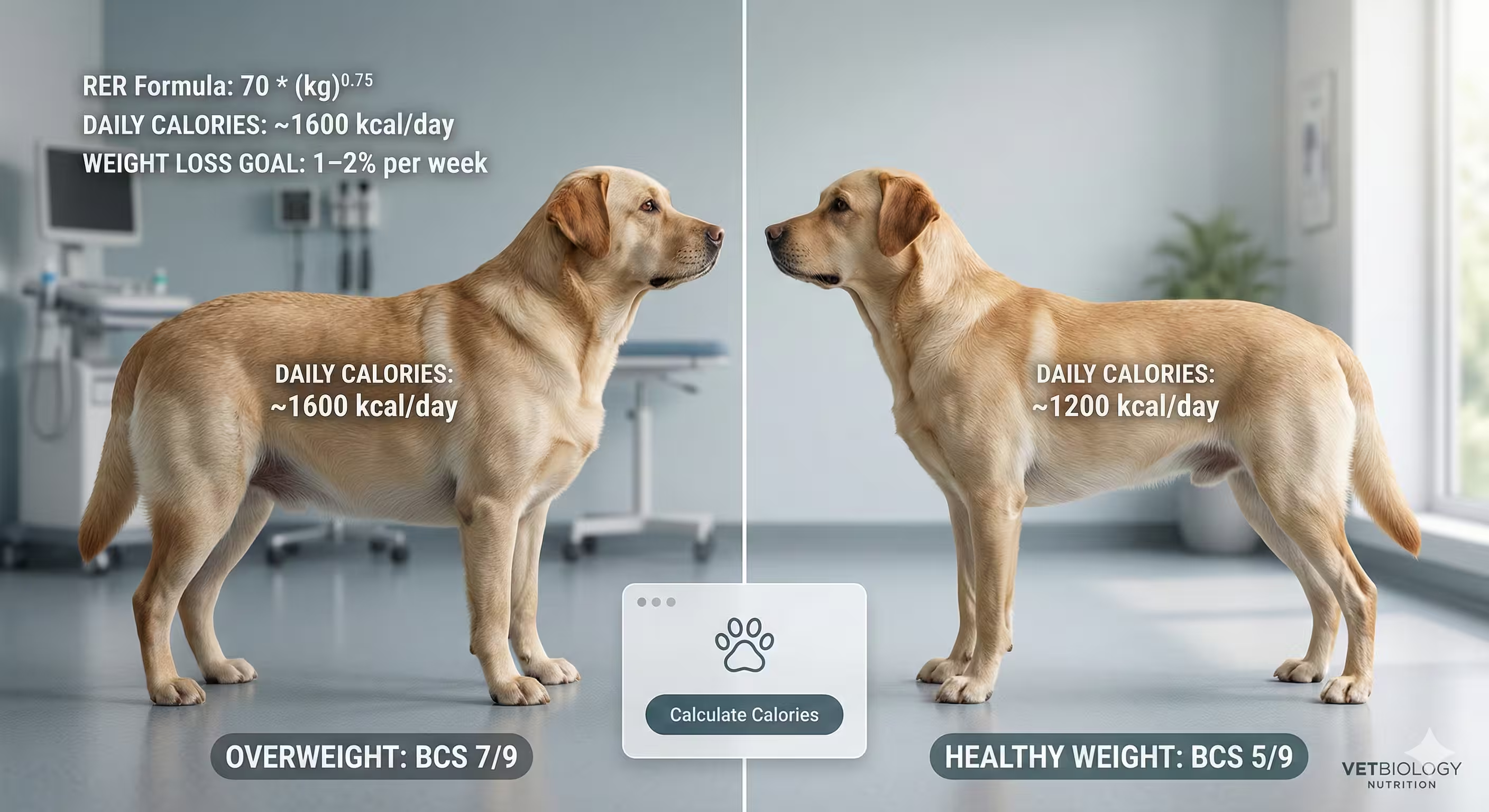

You know your dog needs to lose weight. Your vet said so, or maybe you noticed the belly dragging a little lower, the walks getting shorter, and the breathing getting heavier. But here's where most owners get stuck: how many calories should you actually feed?
Too many and nothing changes. Too few and you risk malnutrition, muscle wasting, or even liver damage.
I'm going to show you the exact formula veterinary nutritionists use to calculate your dog's weight loss calories — the same one taught in vet schools and used in clinics worldwide. Then I'll break it down with real breed examples so you can walk away from this article with a specific number for your dog.
Or, if math isn't your thing, just skip straight to our free calorie calculator — it does the work in 30 seconds.
The Veterinary Formula: How Vets Calculate Weight Loss Calories
Every veterinary nutritionist in the world uses the same starting point: the Resting Energy Requirement (RER) formula.
RER (kcal/day) = 70 × (ideal body weight in kg) ^ 0.75
Let me break that down:
- 70 is a constant — the baseline metabolic rate coefficient for dogs
- Ideal body weight in kg — this is critical. You use your dog's target weight, not their current overweight number
- ^ 0.75 means "raised to the power of 0.75" — this accounts for the fact that metabolic rate doesn't scale linearly with body size
A Worked Example
Let's say you have a Labrador who currently weighs 90 lbs (40.8 kg), and your vet says the ideal weight is 70 lbs (31.8 kg).
Step 1: Convert ideal weight to kg → 70 ÷ 2.205 = 31.8 kg
Step 2: Calculate RER → 70 × (31.8) ^ 0.75 = 70 × 13.38 = 937 kcal/day
Step 3: For weight loss, feed 80–100% of RER for the ideal weight:
- Conservative approach: 937 × 1.0 = 937 kcal/day
- Moderate approach: 937 × 0.8 = 750 kcal/day
So this Lab needs roughly 750–937 calories per day to lose weight safely. That's it. That's the number.
Don't want to do the math? Our free pet calorie calculator does this automatically. Enter your dog's breed, current weight, and select "weight loss" as the goal. You'll get a precise calorie target in seconds — the same formula, zero math required.
Dog Weight Loss Calorie Chart (By Size and Breed)
Here's the chart everyone Googles but nobody actually shows with real breed examples. I've calculated RER-based weight loss calories for 12 common breeds so you can find yours fast:
| Breed | Ideal Weight | RER (kcal) | Weight Loss Range (80-100% RER) |
|---|---|---|---|
| Chihuahua | 5 lbs (2.3 kg) | 131 | 105–131 kcal/day |
| Pomeranian | 6 lbs (2.7 kg) | 147 | 118–147 kcal/day |
| French Bulldog | 24 lbs (10.9 kg) | 420 | 336–420 kcal/day |
| Beagle | 25 lbs (11.3 kg) | 431 | 345–431 kcal/day |
| Cocker Spaniel | 28 lbs (12.7 kg) | 471 | 377–471 kcal/day |
| Australian Shepherd | 55 lbs (24.9 kg) | 780 | 624–780 kcal/day |
| Labrador Retriever | 70 lbs (31.8 kg) | 937 | 750–937 kcal/day |
| Golden Retriever | 65 lbs (29.5 kg) | 886 | 709–886 kcal/day |
| German Shepherd | 75 lbs (34 kg) | 986 | 789–986 kcal/day |
| Rottweiler | 100 lbs (45.4 kg) | 1,224 | 979–1,224 kcal/day |
| Great Dane | 130 lbs (59 kg) | 1,490 | 1,192–1,490 kcal/day |
| Saint Bernard | 150 lbs (68 kg) | 1,658 | 1,326–1,658 kcal/day |
💡 Looking for the complete formula and other weights? Use our dedicated Dog RER Calculator for full pound and kilogram lookup tables and MER multipliers.
Don't see your breed? We have calorie profiles for 250+ dog breeds — or just use the calculator for instant results.
How to Read This Chart
- Start at the higher end (100% RER) for the first 2 weeks
- Drop to 80% RER if your dog isn't losing at least 1% body weight per week after 2 weeks
- Never go below 60% RER without direct veterinary supervision — that's the danger zone for nutritional deficiencies
Why You Can't Just Eyeball It
Here's the uncomfortable truth about why calorie counting matters for dogs:
A single tablespoon of peanut butter = 94 calories One Milk-Bone biscuit = 40 calories A slice of cheese = 113 calories
For a 25-pound Beagle on a weight loss plan of 350 calories per day, that one tablespoon of peanut butter just consumed 27% of their entire daily budget. That slice of cheese your kids slipped under the table? Third of the day's calories — gone.
This is why 90% of dog weight loss attempts fail. Not because the food is wrong, but because nobody is counting the extras.
What you need:
- A digital kitchen scale (~$10 on Amazon) — measuring cups overestimate portions by 20–50%
- A written daily log — food in grams + every single treat, including training rewards
- Every person in the house on the same page — post the rules on the fridge
The 90/10 Treat Rule (Non-Negotiable)
Your dog's treats — all of them, including training rewards, dental chews, and "just a little bite" from dinner — must total no more than 10% of daily calories.
Here's what that looks like in practice:
| Dog's Daily Calorie Budget | Max Treat Calories | That's roughly... |
|---|---|---|
| 300 kcal (small breed) | 30 kcal | 7 baby carrots, or 1 small training treat |
| 500 kcal (medium breed) | 50 kcal | 1 Milk-Bone + a few green beans |
| 800 kcal (large breed) | 80 kcal | 2 small treats, or 20 baby carrots |
Best low-calorie treats:
- Baby carrots — 4 kcal each
- Green beans (plain) — 7 kcal per 10 beans
- Apple slices (no seeds) — 15 kcal per slice
- Ice cubes — 0 calories (most dogs love them)
- Plain cooked chicken — 12 kcal per small piece
Whatever treats your dog gets today, subtract those calories from their food portion. Not tomorrow. Today.
The 8-Week Weight Loss Timeline: What to Expect
Healthy weight loss for dogs is 1–2% of body weight per week. Here's what a realistic timeline looks like for a 70-lb Lab trying to reach 60 lbs:
| Week | Expected Weight | Loss This Week | Total Lost |
|---|---|---|---|
| 0 (Start) | 70.0 lbs | — | — |
| 1 | 69.3 lbs | 0.7 lb | 0.7 lb |
| 2 | 68.6 lbs | 0.7 lb | 1.4 lbs |
| 3 | 67.9 lbs | 0.7 lb | 2.1 lbs |
| 4 | 67.2 lbs | 0.7 lb | 2.8 lbs |
| 6 | 65.8 lbs | 1.4 lbs (2 wks) | 4.2 lbs |
| 8 | 64.4 lbs | 1.4 lbs (2 wks) | 5.6 lbs |
At this pace, our Lab would reach 60 lbs in approximately 14–16 weeks. That feels slow, I know. But this is how you lose fat while preserving muscle — the goal isn't just a lower number on the scale. It's a leaner, healthier, more energetic dog.
If weight loss stalls for 2+ consecutive weeks:
- Double-check that no one in the house is sneaking treats
- Reduce daily calories by 10%
- Add 5 extra minutes to daily walks
- Call your vet if it still doesn't budge — thyroid issues are common in overweight dogs
High-Quality Weight Management Dog Foods (AAHA & NRC Aligned)
The food you choose matters almost as much as the calorie count. Regular adult dog food at reduced portions leaves your dog nutritionally deficient — less food means less of every vitamin, mineral, and amino acid they need.
Weight management formulas solve this by packing complete nutrition into fewer calories, with higher protein (to preserve muscle), more fiber (to keep them full), and lower fat.
🏆 #1 Pick: Hill's Science Diet Perfect Weight
Hill's Science Diet Perfect Weight — Chicken Recipe, 25 lb Bag
- 4.7 stars on Amazon, 337+ reviews, Amazon's Choice
- Veterinary therapeutic diet — formulated for canine metabolic support
- Nutrient-dense formulation — designed for calorie-restricted feeding without compromising micronutrients
- L-carnitine + coconut oil — actively converts stored fat into energy
- High lean protein + prebiotic fiber — satisfying meals at fewer calories
- 100% satisfaction guarantee from Hill's
- Price: $92.99 for 25 lbs ($3.72/lb) — Save 5% with Subscribe & Save
Real results: Reviewers consistently report 5–20 lb weight loss within 2–3 months. One Golden Retriever lost 20 pounds in 8 weeks. A Corgi gained noticeably more energy after losing just 2 pounds.
💰 Budget Pick: Purina Pro Plan Weight Management
Purina Pro Plan Weight Management — Shredded Blend, 34 lb Bag
- 4.6 stars on Amazon with 6,074 reviews, Amazon's Choice
- High fiber and protein profile — maintains lean muscle during calorie restriction
- Shredded blend texture — crunchy kibble + tender meaty pieces dogs love
- Live probiotics (guaranteed) — better digestion means better nutrient absorption
- High protein, low fat with omega fatty acids for skin and coat
- Price: $77.48 for 34 lbs ($2.28/lb) — 39% cheaper per pound than Hill's
Check Purina Pro Plan Weight Management on Amazon →
Quick comparison:
| Feature | Hill's Perfect Weight | Purina Pro Plan |
|---|---|---|
| Rating | ⭐ 4.7 (337 reviews) | ⭐ 4.6 (6,074 reviews) |
| Sales/month | 1,000+ | 4,000+ |
| Price per lb | $3.72 | $2.28 |
| Key advantage | Clinical proof, L-carnitine | Probiotics, shredded texture |
| Best for | Maximum results | Budget buyers, picky eaters |
How to Transition Without Stomach Issues
Never swap food overnight. Senior and overweight dogs often have sensitive stomachs, and sudden changes cause vomiting, diarrhea, and food refusal.
The safe 10-day transition:
- Days 1–3: 75% old food + 25% new weight loss food
- Days 4–6: 50/50 mix
- Days 7–9: 25% old food + 75% new food
- Day 10+: 100% new food
If you see loose stools, stretch the transition to 14 days. Watch stool consistency — it's the single best indicator of how well your dog's gut is handling the change.
Three Common Mistakes That Sabotage Dog Weight Loss
Mistake #1: Using the Feeding Guide on the Bag
Those guidelines are designed for active, intact, average-metabolism adult dogs. If your dog is spayed/neutered, sedentary, or a breed prone to weight gain (Labs, Beagles, Pugs, Dachshunds, Bulldogs), the bag's recommendation is 20–30% too high.
Always calculate based on your dog's individual calorie needs, not generic bag instructions.
Mistake #2: Forgetting About the Rest of the Family
Dad sneaks a bite of steak. The toddler drops half their sandwich. Grandma gives "just one more treat." These invisible calories add up to 100–200+ kcal/day in many households — enough to completely cancel out a carefully measured dinner.
Solution: Everyone in the house must know the daily calorie budget. Put a whiteboard on the fridge. Log every treat.
Mistake #3: Cutting Too Aggressively
Dropping your dog's food by 50% overnight can cause hepatic lipidosis (fatty liver disease), muscle loss, lethargy, and nutritional deficiencies. The body goes into starvation mode and actually holds onto fat.
Never reduce calories by more than 20% from current intake without veterinary guidance. Slow and steady wins this race — every time.
Frequently Asked Questions
How many calories does a 50 lb dog need to lose weight?
A 50-lb dog at ideal weight has an RER of approximately 700 kcal/day. For weight loss, feed 80–100% of RER, which means roughly 560–700 calories per day. But if 50 lbs isn't their ideal weight (if they should be 40 lbs, for example), calculate RER using 40 lbs instead. Use our calculator for precision.
How fast should my dog lose weight?
The safe rate is 1–2% of body weight per week, or about 3–5% per month. For a 60-lb dog, that's 0.6–1.2 lbs per week. Anything faster risks muscle loss and nutritional deficiency.
Should I feed my dog once or twice a day for weight loss?
Twice a day minimum, ideally three times. Splitting calories across multiple meals stabilizes blood sugar, reduces hunger-driven begging, and prevents the "gorge and starve" cycle that slows metabolism.
Can I just exercise my dog more instead of cutting calories?
Exercise helps, but diet accounts for 60–70% of weight loss in dogs. A 30-minute walk burns roughly 100–150 calories for a medium dog — that's less than one dental chew. You can't outrun a bad diet, and the same is true for dogs.
My dog acts hungry all the time on reduced calories. What do I do?
This is normal for the first 1–2 weeks. It gets better as their stomach adjusts to smaller portions. In the meantime: add fiber-rich vegetables (green beans, canned pumpkin) to bulk up meals without adding meaningful calories, use a slow feeder bowl to extend mealtime, and make sure they're drinking enough water — thirst is often mistaken for hunger.
Is grain-free food better for weight loss?
No. In fact, the FDA has been investigating a link between grain-free diets and heart disease (dilated cardiomyopathy) in dogs. Healthy whole grains like brown rice, oatmeal, and barley provide valuable fiber that helps overweight dogs feel full. Stick with grain-inclusive food unless your vet has diagnosed a specific grain allergy.
How do I know when my dog has reached their ideal weight?
The easiest home test: run your hands along their sides. You should be able to feel each rib with gentle pressure, but not see them prominently. From above, there should be a visible waist tapering inward between ribs and hips. From the side, the belly should tuck upward. Your vet can confirm with a formal body condition score (BCS) — ideal is 4–5 on the 1-to-9 scale.
Should I use a weight loss supplement for my dog?
For most dogs, the combination of calorie reduction + weight management food + increased exercise is sufficient. Supplements with L-carnitine (already included in Hill's Perfect Weight) can support fat metabolism. Joint supplements like glucosamine are helpful if excess weight has caused joint pain or stiffness. Never rely on supplements alone — they support a diet plan, they don't replace one.
Your Dog's Weight Loss Starts With One Number
Everything in this guide — the food choices, the treat budgets, the transition schedule — depends on one thing: knowing exactly how many calories your dog needs per day to lose weight safely.
Get that number right now. Use our free calorie calculator — enter your dog's breed, current weight, age, and activity level, then select the weight loss goal. It takes 30 seconds, it's completely free, and it uses the same RER formula that every veterinary nutritionist in the world relies on.
56% of dogs in America are overweight. Your dog doesn't have to be one of them. And the fix starts with a single number. Go get yours.
Disclosure: This post contains affiliate links. If you purchase through our links, we may earn a small commission at no extra cost to you. We only recommend products we genuinely believe will help your pet.