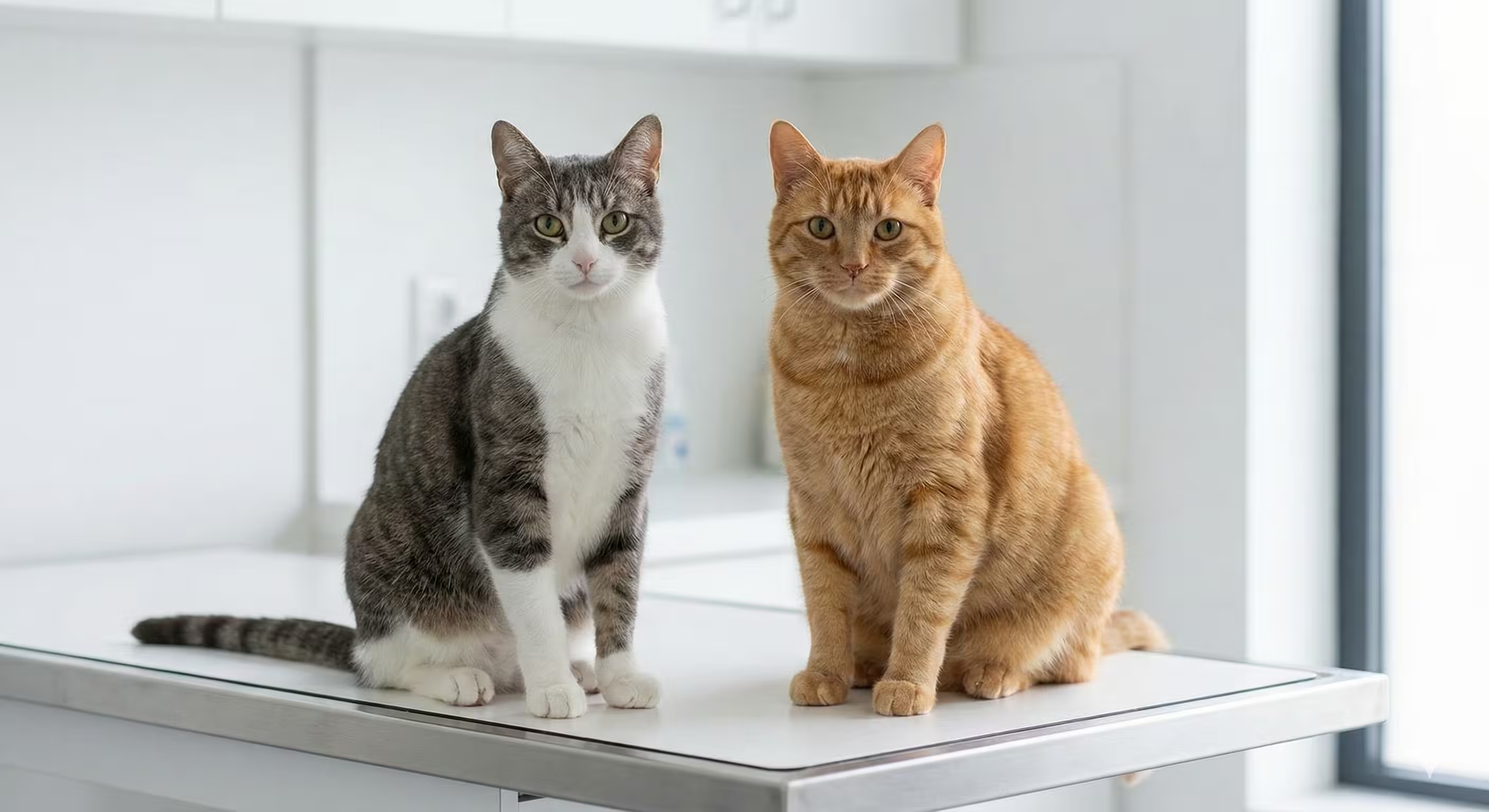

Most cat owners pour kibble into a bowl and hope for the best. No measuring. No math. Just vibes.
And then one day the vet says: "Your cat is overweight."
Here's the reality: 60% of cats in the United States are overweight or obese, according to the Association for Pet Obesity Prevention. That's more than half of every cat sitting on every couch reading this with you right now. And the number one reason? Nobody counts their cat's calories.
The good news: figuring out exactly how many calories your cat needs takes about 30 seconds — if you know the formula. In this guide, I'll show you the exact same calculation veterinary nutritionists use, give you breed-specific calorie charts, and walk you through every life stage from kitten to senior. No guessing required.
Or skip the math entirely — our free cat calorie calculator does it all for you.
How Veterinarians Calculate Your Cat's Daily Calories
Every vet in the world uses the same starting point: the Resting Energy Requirement (RER) formula.
RER (kcal/day) = 70 × (body weight in kg) ^ 0.75
Let me break that down:
- 70 is a constant — the baseline metabolic rate coefficient for cats (and dogs, actually)
- Body weight in kg — your cat's current weight converted to kilograms (divide pounds by 2.205)
- ^ 0.75 means "raised to the power of 0.75" — this accounts for the fact that smaller animals have faster metabolic rates per unit of body weight
RER tells you how many calories your cat burns just by existing — breathing, circulating blood, maintaining body temperature. It doesn't include walking, playing, or terrorizing your ankles at 3 AM.
To get the actual daily calorie need, you multiply RER by a life stage factor:
| Life Stage / Condition | Multiplier |
|---|---|
| Neutered adult cat | 1.0 – 1.2 × RER |
| Intact adult cat | 1.2 – 1.4 × RER |
| Weight loss | 0.8 × RER (for ideal weight) |
| Weight gain | 1.2 – 1.8 × RER |
| Kitten (0–4 months) | 2.5 × RER |
| Kitten (4–12 months) | 2.0 × RER |
| Senior cat (10+ years) | 0.9 – 1.1 × RER |
| Pregnant cat | 1.6 – 2.0 × RER |
| Lactating cat | 2.0 – 6.0 × RER |
These multipliers come from veterinary nutrition textbooks and are used by board-certified veterinary nutritionists worldwide.
A Worked Example: How Many Calories Does a 10-Pound Cat Need?
Let's calculate step by step for an average adult neutered indoor cat weighing 10 lbs.
Step 1: Convert weight to kg → 10 ÷ 2.205 = 4.54 kg
Step 2: Calculate RER → 70 × (4.54) ^ 0.75 = 70 × 3.27 = 229 kcal/day
Step 3: Apply the multiplier for a neutered adult → 229 × 1.0 = 229 kcal/day
So a healthy, neutered, moderately active 10-pound cat needs approximately 200–250 calories per day. That's it. That's the number.
For an intact adult cat at the same weight: 229 × 1.2 = 275 kcal/day.
For an overweight 10-pound cat whose ideal weight is 8 lbs (3.63 kg): RER at ideal weight = 70 × (3.63) ^ 0.75 = 70 × 2.75 = 193 kcal. For weight loss: 193 × 0.8 = 154 kcal/day.
Don't want to do the math? Our free cat calorie calculator does this automatically. Select "Cat," enter the weight, choose the activity level, and you'll get a precise calorie target in seconds — the same formula, zero math required.
Cat Calorie Chart by Weight (Quick Reference)
Here's the chart everyone searches for. I've calculated RER-based maintenance calories for common cat weights so you can find yours fast:
| Cat Weight (lbs) | Cat Weight (kg) | RER (kcal) | Neutered Adult (kcal/day) | Intact Adult (kcal/day) | Weight Loss Target (kcal/day) |
|---|---|---|---|---|---|
| 5 | 2.3 | 130 | 130–155 | 155–180 | 104 |
| 6 | 2.7 | 147 | 147–175 | 175–205 | 118 |
| 7 | 3.2 | 163 | 163–195 | 195–228 | 130 |
| 8 | 3.6 | 178 | 178–215 | 215–250 | 142 |
| 9 | 4.1 | 196 | 196–235 | 235–275 | 157 |
| 10 | 4.5 | 211 | 211–255 | 255–295 | 169 |
| 11 | 5.0 | 234 | 234–280 | 280–328 | 187 |
| 12 | 5.4 | 247 | 247–295 | 295–345 | 198 |
| 13 | 5.9 | 264 | 264–315 | 315–370 | 211 |
| 14 | 6.4 | 280 | 280–335 | 335–390 | 224 |
| 15 | 6.8 | 295 | 295–355 | 355–415 | 236 |
| 18 | 8.2 | 340 | 340–410 | 410–475 | 272 |
| 20 | 9.1 | 370 | 370–445 | 445–520 | 296 |
Important: Weight loss targets assume feeding at 0.8 × RER for the current weight. Your vet may calculate based on ideal body weight instead. Always confirm with your veterinarian before starting a weight loss plan — cats are at risk of hepatic lipidosis (fatty liver disease) if they lose weight too quickly.
Want personalized numbers for your specific cat? Use our cat calorie calculator — it factors in breed, age, activity level, and weight goals.
How Many Calories Does a Kitten Need?
Kittens are not small cats. They're growing machines that burn through calories at an astonishing rate.
A kitten's calorie needs are 2 to 2.5 times higher per pound of body weight compared to an adult cat. Here's why: kittens double their birth weight by the first week, then triple it by the third week. That explosive growth requires serious fuel.
Kitten Calorie Chart by Age
| Age | Weight Range | Daily Calories (approx.) | Feeding Frequency |
|---|---|---|---|
| 0–4 weeks | 3–16 oz | Fed by mother / KMR formula | Every 2–4 hours |
| 4–8 weeks | 1–2 lbs | 200–260 kcal/day | 4–5 meals/day |
| 2–4 months | 2–4 lbs | 250–360 kcal/day | 3–4 meals/day |
| 4–6 months | 4–6 lbs | 250–390 kcal/day | 3 meals/day |
| 6–9 months | 5–8 lbs | 200–330 kcal/day | 2–3 meals/day |
| 9–12 months | 7–10 lbs | 200–280 kcal/day | 2 meals/day |
Key Kitten Feeding Rules
- Never restrict a kitten's calories unless directed by a veterinarian. Underfed kittens face developmental problems.
- Use kitten-specific food — it has higher protein, fat, and essential nutrients like DHA for brain development.
- Transition to adult food between 10–12 months for most breeds (large breeds like Maine Coons may stay on kitten food until 18 months).
- Weigh weekly — kittens should gain roughly 100 grams (3.5 oz) per week until 6 months old.
How Many Calories Does a Senior Cat Need?
Cats over 10 years old present a nutritional paradox. Their metabolism slows down, but many senior cats actually lose weight because they struggle to absorb nutrients as efficiently.
Senior Cat Calorie Guidelines
| Age Range | Calorie Adjustment | Key Considerations |
|---|---|---|
| 10–12 years | 0.9 – 1.0 × RER | Monitor weight closely; may need a slight decrease |
| 12–15 years | 1.0 – 1.1 × RER | Some cats need more calories due to poor absorption |
| 15+ years | 1.1 – 1.2 × RER | Higher protein, increased calorie density often needed |
The biggest mistake with senior cats is automatically cutting calories because "they're old and less active." Many geriatric cats are actually underweight, and restricting food further worsens muscle loss (sarcopenia).
What to do instead:
- Weigh your senior cat monthly. A half-pound loss in a 10-pound cat is a 5% body weight drop — significant enough to warrant a vet visit.
- Increase protein. Senior cats need more protein to maintain lean muscle mass, not less.
- Consider wet food. Hydration becomes increasingly important for kidney health, and wet food delivers more water per calorie.
- Use our cat calorie calculator to adjust targets quarterly as your cat ages.
Indoor Cat vs. Outdoor Cat: How Activity Level Changes Calories
This is one of the most underrated factors in cat nutrition.
| Activity Level | Description | Calorie Multiplier | Example (10-lb cat) |
|---|---|---|---|
| Indoor / Sedentary | Sleeps most of the day, minimal play | 1.0 × RER | ~200–215 kcal/day |
| Indoor / Moderately Active | Regular play sessions, interactive toys | 1.1 × RER | ~230–245 kcal/day |
| Indoor/Outdoor | Access to yard, hunts occasionally | 1.2 × RER | ~250–270 kcal/day |
| Outdoor / Highly Active | Primarily outdoor, hunts regularly | 1.4 × RER | ~295–310 kcal/day |
A strictly indoor cat who sleeps 18 hours a day can need 30–40% fewer calories than an outdoor cat of the same weight. If you're feeding both cats the same amount, one is getting overfed.
Cat Calorie Calculator for Weight Loss: A Safe Step-by-Step Plan
If your vet has confirmed your cat needs to lose weight, here's exactly how to do it safely.
Step 1: Determine the Target Weight
Your vet will tell you your cat's ideal weight based on body condition score (BCS). If you don't have a vet assessment, a general rule: most domestic shorthair cats should weigh between 8–10 lbs (3.6–4.5 kg). Larger breeds like Maine Coons or Ragdolls can be 12–18 lbs and healthy.
Step 2: Calculate Weight Loss Calories
Use the RER formula with the ideal body weight and multiply by 0.8:
Weight Loss Calories = 70 × (ideal weight in kg) ^ 0.75 × 0.8
Example: If your cat currently weighs 14 lbs but should be 10 lbs:
- Ideal weight = 10 lbs = 4.54 kg
- RER = 70 × (4.54) ^ 0.75 = 229 kcal
- Weight loss target = 229 × 0.8 = 183 kcal/day
Or use the PetCalorie Calculator — select "Weight Loss" as the goal, enter your cat's current and ideal weight, and get an instant answer.
Step 3: Pick the Right Food
Not all cat foods are equal for weight loss.
| Food Type | Avg kcal per 100g | Pros | Cons |
|---|---|---|---|
| Dry kibble (standard) | 350–400 | Convenient, affordable | Very calorie-dense, easy to overfeed |
| Dry kibble (weight management) | 280–320 | Lower calories, higher fiber | Still easy to over-portion |
| Wet food (standard) | 80–120 | High moisture, more satiating | Multiple cans needed per day |
| Wet food (weight management) | 60–90 | Lowest calorie density, filling | Can be expensive |
Pro tip: Switching to a wet food or mixed diet is one of the simplest ways to cut calories without leaving your cat hungry. A cup of dry food has roughly 400 kcal; the same volume of wet food has about 100 kcal.
Step 4: Measure Everything
- Use a digital kitchen scale (measure in grams, not cups)
- Measuring cups can overestimate portions by 20–50%
- Subtract treat calories from the daily food allowance
- If multiple people feed the cat, post the daily plan on the fridge
Step 5: Monitor Progress
- Weigh your cat every 1–2 weeks
- Safe rate: 0.5–1% of body weight per week (for a 14-lb cat, that's about 1–2 oz per week)
- If your cat loses more than 2% per week, increase food immediately — rapid weight loss causes hepatic lipidosis, which can be fatal
- Expect to reach ideal weight in 6–8 months for most overweight cats
The 90/10 Treat Rule for Cats (Non-Negotiable)
Your cat's treats — including those Temptations they scream for at 5 AM — must total no more than 10% of daily calories.
For a cat eating 230 kcal/day, that's a treat budget of 23 calories. Here's what fits:
| Treat | Calories |
|---|---|
| 1 Temptations treat | 2 kcal |
| 1 Greenies dental treat | 1.5 kcal |
| Small piece of cooked chicken (5g) | 8 kcal |
| 1 freeze-dried salmon treat | 3 kcal |
| 1 Churu tube (14g) | 6 kcal |
| Slice of deli turkey (10g) | 10 kcal |
So at 230 kcal/day, your cat can have about 10–12 Temptations treats — but subtract those 20–24 kcal from their food. Most people forget this step and wonder why the weight won't come off.
Wet Food vs. Dry Food: Calories Compared
One of the most common questions from cat owners: "Is wet food or dry food better for my cat?"
From a pure calorie perspective, the numbers speak for themselves:
| Dry Food (per cup) | Wet Food (per 5.5 oz can) | |
|---|---|---|
| Average calories | 350–450 kcal | 100–180 kcal |
| Moisture content | 6–10% | 75–85% |
| Protein (dry matter) | 30–40% | 40–55% |
| Calorie density | Very high | Low to moderate |
Why this matters for weight management:
- A cat eating 1/2 cup of dry food gets ~200 kcal from a tiny portion. Still hungry.
- A cat eating 1.5 cans of wet food gets ~200 kcal from a much larger volume. More satisfied.
Wet food also supports kidney health through hydration — particularly important since cats evolved as desert animals and are naturally poor drinkers.
Cat Calorie Needs by Breed
Different breeds have different metabolic rates, body frames, and activity tendencies. Here's a breed-specific reference:
| Breed | Typical Adult Weight | Daily Calories (Neutered Adult) | Notes |
|---|---|---|---|
| Siamese | 6–10 lbs | 170–250 kcal | High energy, lean build |
| Persian | 7–12 lbs | 190–290 kcal | Lower activity, watch weight |
| Maine Coon | 10–25 lbs | 250–500 kcal | Large breed, slow to mature |
| Ragdoll | 10–20 lbs | 250–445 kcal | Moderate activity, big frame |
| Bengal | 8–15 lbs | 225–355 kcal | Very active, high metabolism |
| British Shorthair | 9–17 lbs | 220–390 kcal | Prone to weight gain |
| Abyssinian | 6–10 lbs | 170–250 kcal | Very active and athletic |
| Sphynx | 6–12 lbs | 190–300 kcal | Higher metabolism (no fur = more body heat) |
| Scottish Fold | 6–13 lbs | 170–310 kcal | Moderate activity |
| Domestic Shorthair | 8–11 lbs | 210–275 kcal | Most common, varies widely |
| Russian Blue | 7–15 lbs | 190–355 kcal | Can be food-motivated — watch portions |
| Norwegian Forest Cat | 12–16 lbs | 290–370 kcal | Large breed, active |
Explore calorie profiles for all cat breeds on our site, or use the calculator for instant custom results.
How to Read Cat Food Labels for Calories
The calorie information on cat food is required by AAFCO, but it's not exactly easy to find. Here's where to look:
- "Calorie Content" — usually printed on the back or side in small text, listed as "kcal/kg" and "kcal/cup" or "kcal/can"
- Use kcal/can for wet food — divide daily needs by kcal/can to know exactly how many cans to feed
- Use kcal/cup for dry food — but then weigh the food in grams for accuracy (measuring cups are inaccurate)
Quick Math Example
Your cat needs 230 kcal/day. You feed a wet food that has 160 kcal/can.
→ 230 ÷ 160 = 1.44 cans/day (about 1.5 cans)
If mixing wet and dry: → Morning: 1 can (160 kcal) + Evening: 20g of dry food (~70 kcal) = 230 kcal total
Frequently Asked Questions
How many calories does a 10-pound cat need per day?
A healthy, neutered, indoor 10-pound cat needs approximately 200–250 calories per day. Active or intact cats at the same weight may need 250–295 kcal. Use our cat calorie calculator for a precise number tailored to your cat's specific situation.
How many calories should a cat eat to lose weight?
For weight loss, most vets recommend feeding 80% of the RER calculated for the cat's ideal body weight. For example, a cat whose ideal weight is 10 lbs would get about 183 kcal/day for weight loss. Never reduce calories more than 25% below maintenance without veterinary supervision. Cats that lose weight too quickly can develop hepatic lipidosis, a life-threatening liver condition.
How many calories does a kitten need?
Kittens need significantly more calories per pound than adult cats — roughly 2.0–2.5 times the adult RER. A 4-month-old, 3-pound kitten may need 250–300 kcal/day. Never restrict a kitten's calories without a vet's direction, as malnutrition during growth causes permanent developmental issues.
Is wet food or dry food better for cats?
Both can work, but wet food has significant advantages: lower calorie density (easier to manage portions), higher moisture content (supports kidney health), and higher protein content per calorie. For overweight cats specifically, wet food helps them feel fuller on fewer calories. Many veterinary nutritionists recommend at least some wet food in every cat's diet.
How do I know if my cat is overweight?
The easiest method is the rib test: place your hands on your cat's ribcage. You should be able to feel individual ribs with light pressure, similar to the back of your hand. If you need to press firmly to find them, your cat is likely overweight. A body condition score (BCS) assessment from your vet is the gold standard — a score of 4–5 on a 9-point scale is ideal.
How often should I feed my cat?
Most adult cats do well with 2 meals per day (morning and evening), which also makes calorie control much easier than free-feeding. Kittens under 6 months should eat 3–4 times daily. The key is dividing the total daily calories evenly across meals, not feeding "until they're full."
Can I just feed my cat less of their regular food for weight loss?
You can, but it's not ideal. Simply reducing portions of standard food means your cat gets fewer vitamins, minerals, and protein too — potentially causing nutrient deficiencies. Weight management formulas are designed to deliver complete nutrition at lower calorie levels, with extra protein to preserve muscle and extra fiber to keep cats satisfied.
Should I use a weight loss supplement for my cat?
There is limited evidence supporting weight loss supplements for cats. The most effective strategy is calorie control combined with increased activity. L-carnitine is sometimes added to weight management foods and has some supporting research. Always consult your veterinarian before adding any supplement.
Your Cat's Health Starts With One Number
Every overweight cat I've seen in practice started the same way: an owner who didn't know how many calories their cat needed, pouring food into a bowl by feel more than by fact.
Now you know the formula. You know the multipliers. You have the charts. You have the treat budget. You have the tools.
The single most important thing you can do today: calculate your cat's daily calorie target. Takes 30 seconds. Costs nothing. And it could add years to your cat's life.
Your cat can't read nutrition labels. That's your job. Make it count.
Reviewed by Dr. Emma Pawson, DVM — Board-certified in veterinary nutrition with 15+ years of clinical experience in feline medicine.
Sources and References
- Association for Pet Obesity Prevention (APOP) — 2024 National Pet Obesity Survey
- WSAVA Global Nutrition Guidelines
- AAFCO (Association of American Feed Control Officials) — Pet Food Calorie Content Guidelines
- Laflamme, D.P. — "Development and validation of a body condition score system for cats" (Feline Practice, 1997)
- National Research Council — "Nutrient Requirements of Dogs and Cats" (2006)